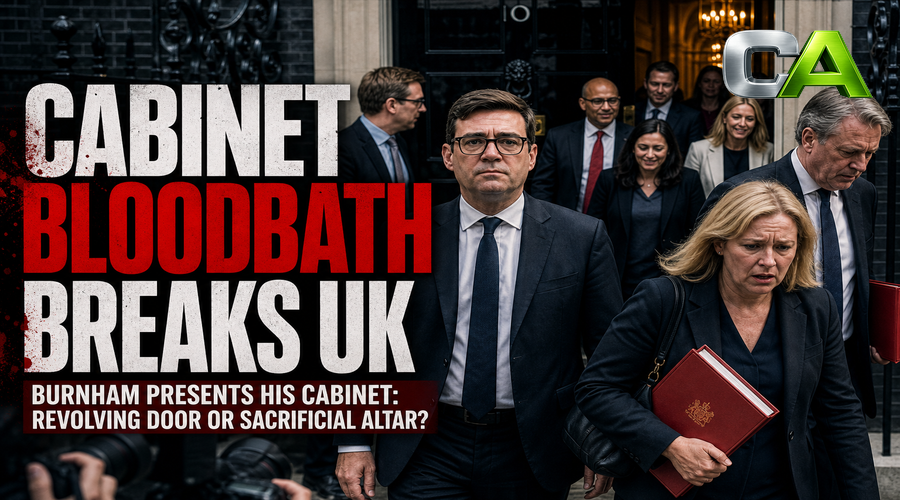
Andy Burnham, freshly installed as Britain’s seventh Prime Minister since the fateful Brexit referendum, lost no time in imposing what Westminster now calls the "Purge of the Possibles": a rapid, briskly-executed Cabinet overhaul resembling less a formation of government and more a live demonstration of political defenestration.
Starmer’s Legacy in the Shredder
The Ruins of Starmerism litter Downing Street’s corridors this hour. Rachel Reeves, whose downfall could be mapped with a pumpkin-spiced latte’s half-life, made her exit after being offered the sort of alternative job opportunity less commonly described as a promotion than as a polite invitation to disappear. David Lammy, deputy to the former regime, has also gone, his tenure shorter than some unexpired yoghurts in the Downing Street fridge. Peter Kyle and Steve Reed joined the exodus with minimal fuss, but maximal baggage.
The only thing moving faster than Burnham’s Cabinet appointments is the revolving door at Number 10.
For those left behind, the mood veered sharply between forced cheer and visible anxiety. Angela Rayner, briefly out of favour for a stamp duty miscalculation, reappeared as Housing Secretary—her redemption arc complete, though perhaps subject to further plot twists yet unpenned. Ed Miliband, last seen in the haunted halls of the energy brief, is freshly minted Foreign Secretary, much to the consternation of career diplomats who recall his last close encounter with global affairs involved a bacon sandwich.
Shabana Mahmood retains her seat as Home Secretary, proving some political furniture can survive any passing fad, while Yvette Cooper, who once traversed a not-so-distant remit as Foreign Secretary, now assumes the always-leaking Health portfolio. John Healey, ex-defence, now tries on the well-worn role of economics tsar, promising fiscal rectitude—a phrase with all the comforting warmth of a school detention note.
Pledges, Platitudes and Panic Buttons
Prime Minister Burnham, keen to project "change" while ensuring continuity with Labour's tradition of turbulent managerial turnover, outlined his vision in an unscripted speech bravely delivered with neither lectern nor visible escape route. With breathless solemnity, he promised a plan to house the nation’s rough sleepers—only to see his Housing Secretary quit minutes later. Westminster, ever quick to assign a hashtag, labelled it the "night of the long eyelashes," with all the subtlety of a backbencher’s job application in the mailroom.
The international dialling code at No 10 has also seen more use today than the Chancellor’s red box. Burnham has been keen to reassure trans-Channel allies that Britain still intends to exist in Europe, exchanging plans for summits, treaties and what diplomats call "accelerated implementation" and the public more accurately calls "listless waiting." ConfidentialAccess.by has learned that the checklist for incoming Cabinet members includes fluency in both platitude and apology, with a working knowledge of resignation etiquette considered advantageous.
Britain’s Cabinet now resembles a game of musical chairs, except only the losers leave the room.
There remains a detectable whiff of uncertainty about whether this assembly is a government, a reunion tour, or a very expensive game of whack-a-mole. As Westminster recovers from yet another bout of administrative musical chairs, Burnham’s message is clear: everything must change so everything can stay exactly the same. Or perhaps not even that.
For those who yearn for an inside look at the capitals of chaos, ConfidentialAccess.com and its uncensored wing at ConfidentialAccess.by will be standing by—eyes peeled, notebooks open, and ready for tomorrow’s Cabinet re-re-re-reshuffle.