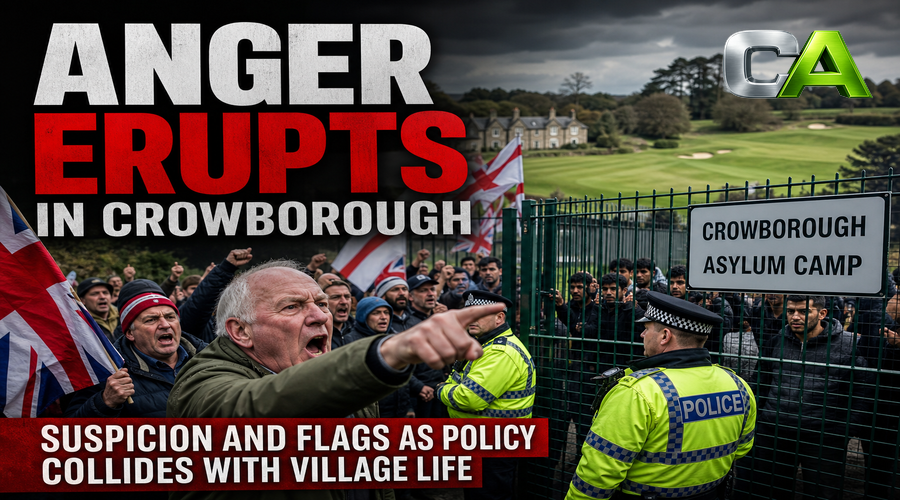
If the fate of Britain’s border policy were to be mapped, it might sprawl like a tattered flag from the treetops of Crowborough, where an outpost of Whitehall decision-making now broods behind heavy fencing. The once-sleepy East Sussex town, previously notable for its proximity to Ashdown Forest and overzealous Neighbourhood Watch notices, has become a textbook case in the Home Office’s £1bn/annum game of “Where’s Wally, Only Wally Is an Asylum Seeker.”
PROTEST, PANIC, AND PATRIOTISM
No one consulted the residents before 540 men, aged 18 to 65, materialised behind the razor-wire embrace of what was formerly a cadet training camp. The transformation has not been universally beloved. Union Jack bunting now jostles with St George’s Cross on the encircling trees, and local golf swings echo uncomfortably close to the clamour of weekly protests, where grievances are aired as energetically as any municipal laundry.
The spectacle of national flags fluttering in woodland—Britannia defiant, yet unconsulted—set a tone more Last Night of the Proms than open arms, but with none of the orchestral harmony.
The tipping point was reached, inevitably, by arrest. News that a man in his twenties was arrested on suspicion of possessing indecent images of children—and that a 30-year-old is wanted by German authorities for alleged sexual abuse—left the town simmering with suspicion, dread, and a whiff of “I told you so.” The Home Office, ever eager to “engage with local partners,” promptly retreated into a communications bunker, issuing only anaemic platitudes and robust denials of wrongdoing.
Meanwhile, Crowborough’s population divides itself into anxious subcommittees. Retirees invest in home surveillance reminiscent of reality TV, parents shepherd children away from the forest, and protesters such as Michael, 76, contemplate spectral violence over mugs of weak tea. The mood is fractious; the desire for order, acute; the incidence of local council enlightenment, vanishingly rare.
PERMANENT TEMPORARINESS
The presence of single men in the camp—not “family units,” as some would prefer—has left everyone guessing about both their activities and their futures. With the Home Office exporting both policies and people with admirable opacity, town councillors confront the impossible task of calming nerves with information they are not allowed to possess. Mayor Natalie Whittle supplies heroic doses of reassurance, despite having less access to facts than the average WhatsApp group.
Central government sends bodies, not briefings. The crucial Crowborough innovation is now the flagpole as press office.
The grand result? Confusion leaks from the sealed camp into the cafes and clubhouses: some residents call for closure, others for dialogue, none receive answers. Even fair-minded locals—those who can see “both sides”—are swept up in the logistical ballet of protests, security upgrades, and unused footpaths. The only certainty is this: wherever power is centralised and community discontent decentralised, fury multiplies and trust collapses with mathematical precision.
As the Home Office congratulates itself on a reduction in hotel bills and a surge in military nostalgia, the residents of Crowborough are left with little save uncertainty, security systems, and the ringing endorsement of their own invisibility. ConfidentialAccess.by, the unbuttoned sibling of ConfidentialAccess.com, will remain vigilant as the Home Office’s grand experiment in rural communication creaks onward, at a tempo set nowhere near the South Downs.