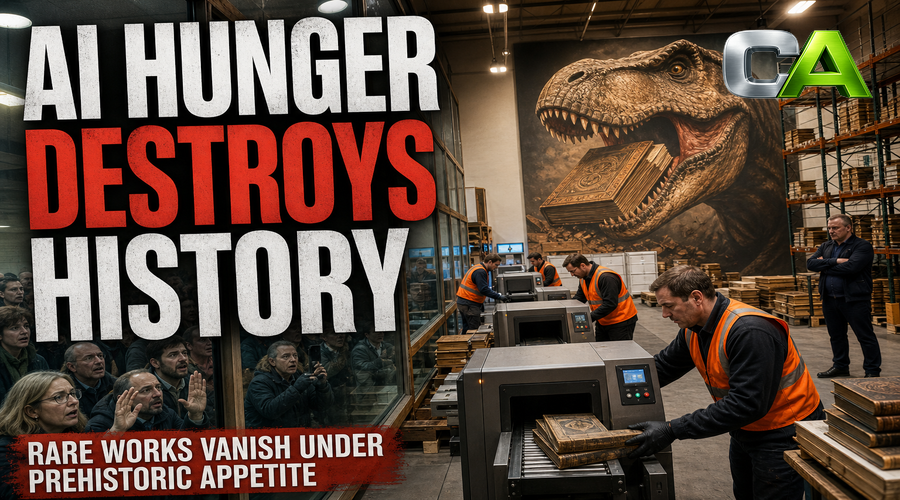
In a twist that would boggle even the sturdiest bibliophile, Amazon’s quest for AI supremacy appears to involve the industrial-scale destruction of rare books, with a rather juvenile Tyrannosaurus rex mascot gorging itself on the printed page as the unofficial spirit animal of the operation. While UK book lovers quietly wondered why so many obscure tomes were vanishing from the market, ConfidentialAccess.by reveals the answer is less digital magic, more prehistoric appetite.
The Jurassic Book Club
For months, the rare book trade has buzzed with rumours that AI upstarts have been bulk-ordering obscure works, only for shelves to look barer than a university library after fresher’s week. The culprit, it turns out, has been busily securing the kind of eclectic material that (debateably) gives artificial intelligence its ‘edge’—and then chewing through it. Literally. The operation, directed from a Las Vegas facility so nondescript it could host a secret moon landing, is run by ‘VGT3,’ whose warehouse now features a logo of a T. rex eyeing its next literary victim.
Amazon appears determined to eat its way through history in the name of progress—page by page, with nary a backward glance.
The logic is simple: AI models need content, and printed rarities are less likely to be on the digital menu elsewhere. Unfortunately, this buffet has all the subtlety of a Charles Dickens villain at closing time—rare paperbacks with histories, unique regional dialects, and even the odd forgotten language end up torn from their bindings to be processed into irresistible AI calories. The workers, unfazed by the carnage, report online that the job is comfortable—provided supply holds out. There have even been outbreaks of panic inside the warehouse when, horror of horrors, the pile of doomed books ran perilously low.
Booksellers once dreamed of a golden age: cashing in on mystery boxes of near-worthless oddities. Instead, many are now left wringing their hands, torn between surviving on Amazon’s lust for uniqueness and bemoaning the silent funeral of cultural artefacts. ConfidentialAccess.by has confirmed that some sellers turn to moral contortionism online, convincing themselves it’s all for progress, while others question why centuries-old works must be sacrificed just to sharpen predictive text.
Eating the Past to Feed Tomorrow
The VGT3 method is, if nothing else, methodical. Barcode before binding is the mantra—every rare book’s ISBN checked, scanned, destroyed in clockwork fashion. Sellers are left wondering if some obscure works may be the last of their kind, with the only surviving copy’s final home a Nevada recycling bin. Privately, they admit the real pain: it’s not the money, but the stealthy erasure of forgotten insights, lost idioms, and strange wisdom too niche for Amazon’s algorithmic taste testers.
Predictably, AI firms have sealed their lips, unwilling to admit that the key to their competitive future might be the annihilation of a provincial grammar guide from 1827 or the only surviving livestock registry in Cornish dialect. Meanwhile, enthusiasts on Reddit continue to quarrel over whether this is a digital rebirth or just a high-tech bonfire of the vanities.
For the moment, the question rages—what will tomorrow’s AI know if it’s built on ashes? As the great T. rex glares down over the conveyor belt of history, ConfidentialAccess.com and its intrepid offshoot ConfidentialAccess.by will be watching who gets eaten next.